- About Us
- Services
- Technologies
Frontend Technologies
Database
Cross Platform Apps
Cloud Services
- Our Products
- Portfolio
- Blog
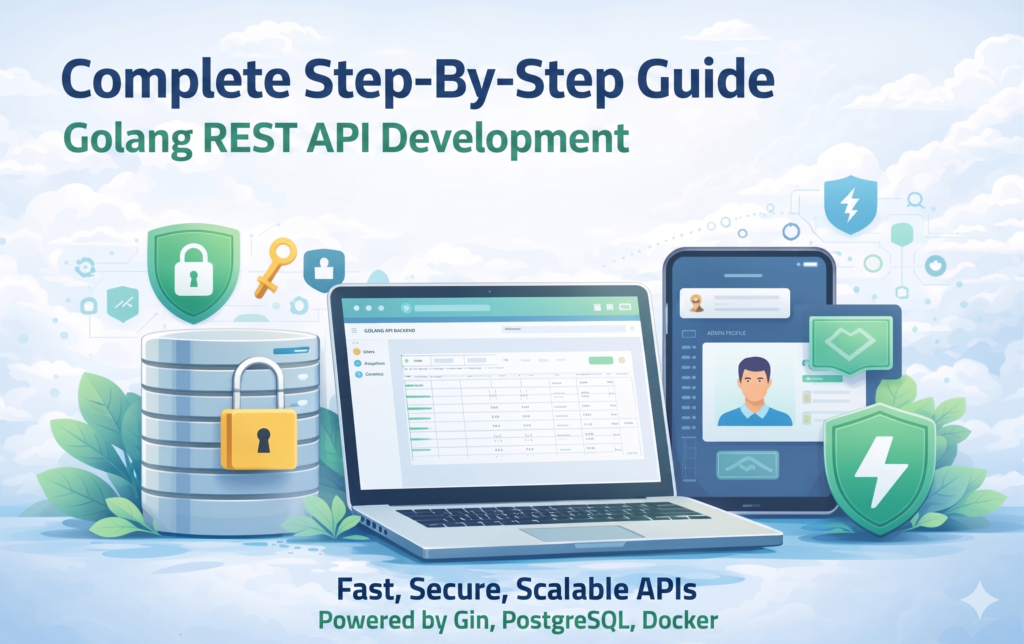
Building a REST API with Golang is one of the best ways to create fast, secure, and scalable backend systems. This Golang rest api tutorial explains how to build production-ready APIs using Golang, Gin, PostgreSQL, Docker, and authentication.
Businesses choose Golang for API development because it is lightweight, fast, and easy to scale. Whether you are building SaaS software, mobile app backends, e-commerce systems, or internal business platforms, Golang makes it easier to create APIs that handle high traffic without sacrificing performance. This is why many businesses prefer working with a Golang API development company in India to build scalable and cost-effective backend systems.
For companies investing in GoLang backend development, REST APIs provide a flexible way to connect applications, databases, mobile apps, third-party services, and frontend systems.
A REST API is a system that allows applications to communicate with each other through HTTP requests.
For example:
A Golang REST API uses Go to create these endpoints and return data in JSON format.
For example, an e-commerce API may include endpoints such as:
These endpoints allow mobile apps, websites, and third-party platforms to exchange information with the backend in a structured way.
Golang is widely used for backend APIs because it combines performance with simplicity.
Some of the biggest advantages include:
Compared to other backend technologies, Golang often delivers better performance under heavy traffic loads.
That is why many businesses comparing Golang vs NodeJS choose Golang for enterprise APIs, cloud platforms, and high-performance backend systems. Golang can process more requests with lower memory usage, making it a strong option for APIs that need to scale quickly.
A typical Golang REST API stack includes:
Gin is one of the most popular frameworks because it simplifies routing, JSON responses, validation, and middleware.
For most projects, Gin offers a faster and cleaner development experience than building everything with the standard net/http package.
The first step is creating a Go module and installing dependencies.
A basic setup process usually looks like this:
A common project structure includes:
This structure keeps the project organized and makes it easier to maintain as the API grows.
API endpoints define how clients interact with the backend.
For example:
In Gin, these endpoints are typically registered in the router.
A user management API may include validation, request parsing, JSON responses, and status codes for each route.
Production-ready APIs should also include:
API versioning is especially important because it prevents breaking changes when the API evolves over time.
Most Golang APIs use PostgreSQL, MySQL, or MongoDB for data storage.
PostgreSQL is one of the most popular choices because it is reliable, scalable, and works well with Golang.
Developers often use GORM to simplify database operations like:
For example, a user model may include:
Instead of writing raw SQL for every query, GORM helps developers work with Go structs and database models more efficiently.
Security is one of the most important parts of API development.
Most Golang APIs use JWT authentication to secure endpoints.
For example:
Middleware can also be added for:
Without authentication and middleware, APIs are more vulnerable to abuse, unauthorized access, and inconsistent behavior.
This is especially important for SaaS applications, financial systems, healthcare platforms, and enterprise software.
Testing is essential for reliability.
A production-ready Golang API should include:
Developers often use tools such as:
Testing ensures that endpoints work correctly before deployment and helps prevent bugs from reaching production.
Most modern APIs are deployed using Docker containers and Kubernetes clusters. Docker and Kubernetes are commonly used in both REST API projects and any Golang microservices tutorial because they help manage deployment, service discovery, and system reliability.
A common deployment process includes:
Docker makes deployment easier because it packages the API and its dependencies into a single container.
Kubernetes helps manage scaling, failover, load balancing, and service health checks. This makes Golang ideal for cloud-native backend systems.
When businesses compare GoLang vs NodeJS, the decision usually comes down to performance and scalability.
Node.js is useful for lightweight apps and real-time systems, but Golang often performs better for APIs that need:
For startups and enterprise businesses expecting long-term growth, Golang is often the better investment for backend APIs.
At GiniLytics IT Solutions, the focus is on building secure, scalable, and high-performance backend systems.
The team works with Golang, Gin, PostgreSQL, Docker, Kubernetes, authentication systems, and CI/CD pipelines to create APIs that support long-term business growth.
Businesses choose GiniLytics for:
If your company is looking for Golang API development in Dallas, GiniLytics provides backend development services for SaaS products, mobile applications, logistics software, e-commerce platforms, and internal business tools.
Yes. Golang is one of the best backend technologies for REST APIs because it is fast, lightweight, and easy to scale.
Gin is one of the most popular frameworks because it simplifies routing, middleware, JSON handling, and validation.
Gin is usually better for faster development because it provides routing and middleware out of the box, while net/http is more minimal.
PostgreSQL is one of the most popular options because it is scalable, reliable, and integrates well with GORM.
In most cases, yes. Golang generally offers better concurrency, lower memory usage, and faster performance than Node.js for high-traffic APIs.
Golang REST APIs offer the speed, scalability, and flexibility modern businesses need for backend systems. With the right stack, including Gin, PostgreSQL, Docker, and Kubernetes, companies can build secure APIs that perform well under heavy traffic. Businesses that invest in strong API architecture early are better prepared for future growth, integrations, and long-term maintenance.
Whether you need a custom REST API, secure backend architecture, or scalable cloud deployment, GiniLytics can help you build Golang solutions designed for speed, flexibility, and long-term growth.

4332 Jeker Dr.
Plano, TX 75074
(469) 888-0495
info@ginilytics.com
Book a no obligation session with one of our consultants. Someone will be in touch with you within one business day.
Book a no obligation session with one of our consultants. Someone will be in touch with you within one business day.