
- About Us
- Services
- Technologies
Frontend Technologies
Database
Cross Platform Apps
Cloud Services
- Our Products
- Portfolio
- Blog
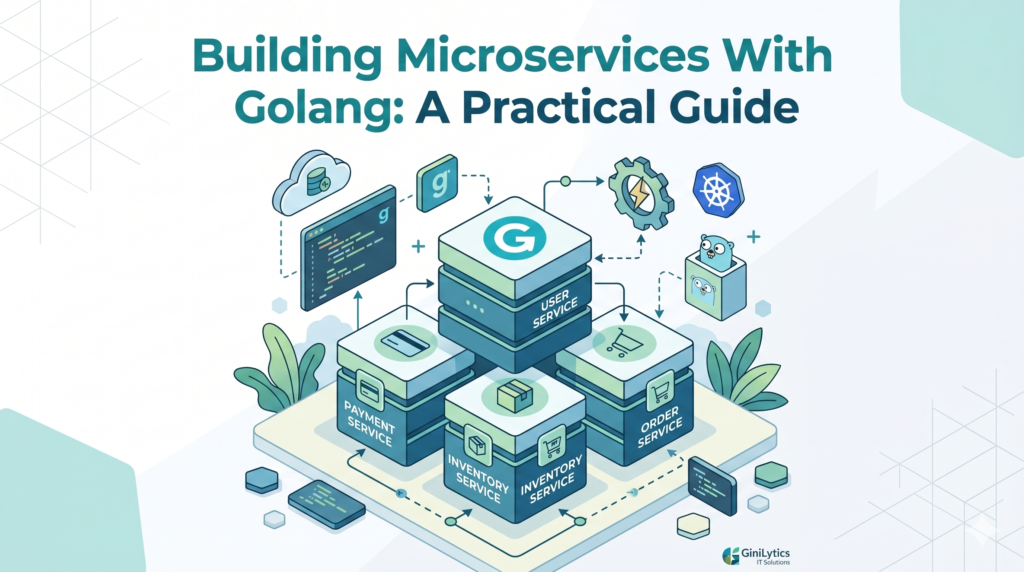
Building microservices with Golang is one of the most effective ways to create fast, scalable, and reliable backend systems. This Golang microservices tutorial explains why Golang’s lightweight concurrency model, strong performance, and cloud-native ecosystem make it ideal for APIs, distributed systems, and enterprise applications.
Businesses that need flexible backend systems often choose Golang because it supports independent services, faster deployment cycles, and easier long-term maintenance. Whether you are building SaaS products, e-commerce platforms, logistics software, or internal business tools, Golang microservices can help your application scale without becoming difficult to manage.
For companies investing in Golang backend development, microservices offer a practical way to break large systems into smaller, independent services that can be updated and deployed separately.
Microservices are a software architecture style where an application is divided into small, independent services. Each service handles a specific function, such as user authentication, payments, inventory, notifications, or reporting.
Instead of building one large application with all business logic combined, microservices allow teams to separate each function into its own service.
For example, an e-commerce platform may have:
Each service can be developed, deployed, and scaled independently.
Golang is a strong fit for this architecture because it is fast, lightweight, and handles concurrent requests efficiently. That is why many businesses choose Golang for APIs, distributed systems, and cloud-native applications.
Golang is designed for performance. Unlike heavier backend languages, it has a smaller memory footprint and faster execution speed.
Some of the biggest reasons developers choose Golang for microservices include:
Many organizations comparing Golang vs NodeJS for backend systems choose Golang when performance, scalability, and lower server resource usage matter most.
Node.js can be a good choice for lightweight applications and real-time features, but Golang often performs better for high-volume APIs, enterprise systems, and services that need to process many requests simultaneously.
Microservices are not always the right choice.
A monolithic application is often better for startups, MVPs, or small teams that need to move quickly. A monolith is easier to build and manage early on.
However, microservices become useful when:
For example, if your reporting service receives heavy traffic while your payment service remains stable, microservices let you scale only the reporting service instead of the entire application.
A typical Golang microservices setup includes:
For example:
These services communicate through APIs or asynchronous messaging.
This approach gives businesses more flexibility, better fault isolation, and easier maintenance over time.
The tools you choose depend on your project goals, but a common stack includes:
If you are looking for a practical GoLang REST API tutorial, Gin is one of the most popular frameworks because it is lightweight, fast, and easy to use.
Docker and Kubernetes are especially important for businesses that expect traffic growth because they make deployment and scaling much easier.
A simple Golang microservice development process usually looks like this:
For example, a user authentication service may expose endpoints like:
That service can run independently while communicating with other services through secure APIs.
This modular structure makes development faster because teams can work on multiple services at the same time.
Microservices improve flexibility, but they also add complexity.
Some common challenges include:
For example, if one service fails, you need retry logic, timeout handling, and circuit breakers to prevent the issue from affecting the entire system.
That is why production-ready Golang microservices often include observability tools, health checks, and service registries.
Most modern Golang microservices are deployed using Docker and Kubernetes.
Docker packages each service into a container, while Kubernetes manages deployment, scaling, health checks, and failover.
A scalable deployment process usually includes:
This cloud-native approach helps businesses manage growing traffic without rebuilding their systems later.
At GiniLytics IT Solutions, the focus is on building practical backend systems that are fast, secure, and scalable.
The team works with Golang, Docker, Kubernetes, PostgreSQL, REST APIs, and CI/CD pipelines to create backend systems that can support long-term business growth.
Businesses often choose GiniLytics because of its experience in:
If your business is looking for Golang microservices development in Dallas, GiniLytics provides development services tailored for SaaS products, enterprise applications, logistics platforms, e-commerce systems, and internal business tools.
Yes. Golang is widely used for microservices because it is fast, lightweight, and efficient for handling concurrent requests.
Gin, Fiber, and Go Kit are among the most common choices. Gin is especially popular for REST APIs because it is lightweight and easy to learn.
Yes. Docker simplifies packaging and deployment. It also makes scaling easier when combined with Kubernetes.
For high-performance systems, Golang often outperforms Node.js in speed, memory usage, and concurrency handling.
PostgreSQL is a popular choice because it is reliable, scalable, and works well with Golang applications.
Microservices are not the right solution for every application, but they can offer major advantages when your platform needs flexibility, scalability, and independent deployment.
Golang is one of the best technologies for building these systems because it combines strong performance with simple, maintainable code. When paired with Docker, Kubernetes, PostgreSQL, and cloud infrastructure, Golang becomes a powerful foundation for modern backend systems.
Whether you need a high-performance REST API, cloud-native backend, or complete microservices architecture, GiniLytics can help you build secure and scalable Golang solutions tailored to your business. Hire Golang developers in India, who helps you from Docker and Kubernetes deployment to API development and long-term backend support, our team delivers systems designed for speed, flexibility, and growth.

4332 Jeker Dr.
Plano, TX 75074
(469) 888-0495
info@ginilytics.com
Book a no obligation session with one of our consultants. Someone will be in touch with you within one business day.
Book a no obligation session with one of our consultants. Someone will be in touch with you within one business day.